Cranial motion is conventionally described through the individual patterns of the bones. That description is useful, but it is not the whole story. What you are palpating is a membrane under tension, breathing.
The reciprocal tension membrane, or RTM, is the dural system that guides and influences cranial bone motion. It is one of the foundational concepts in craniosacral work, and understanding it changes how you hold a skull. This is a short introduction for anyone beginning the study, or for practitioners who want to revisit the fundamentals.
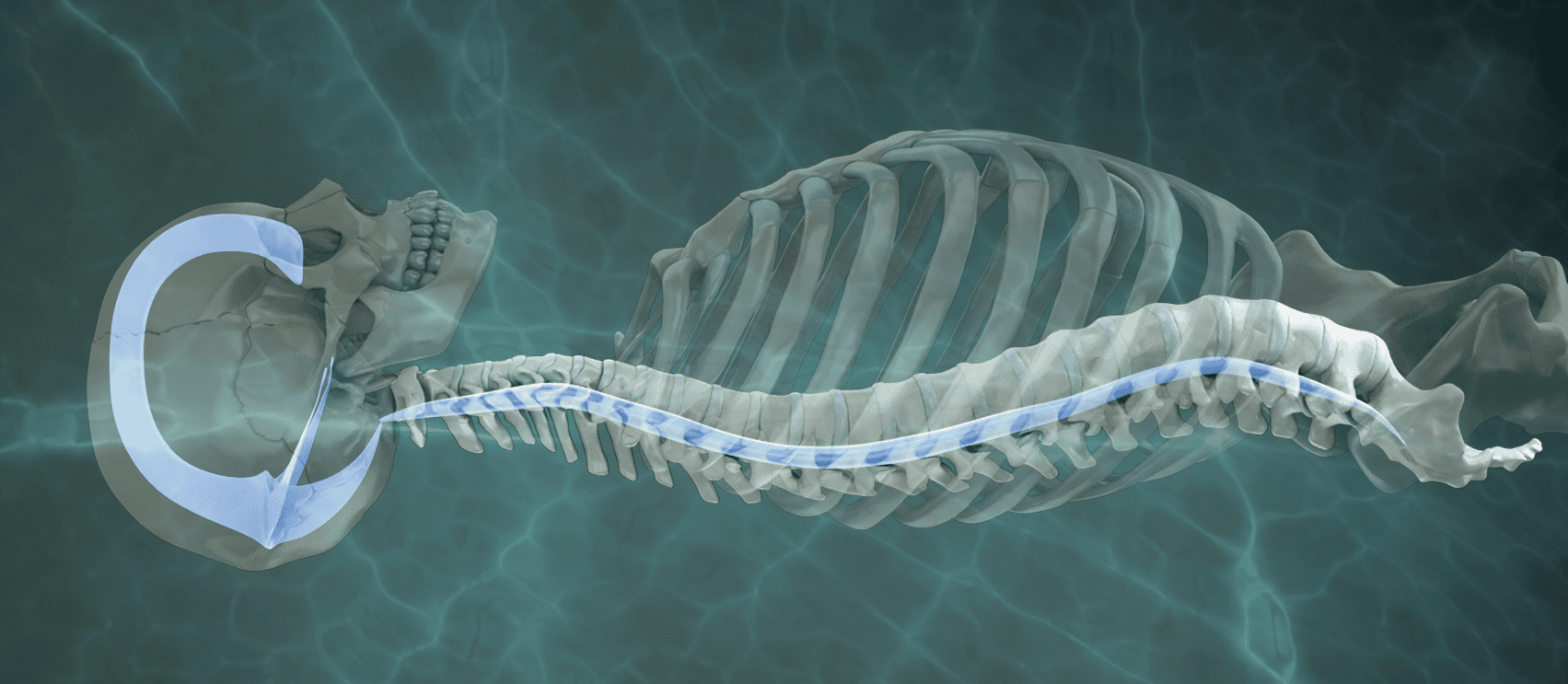
Bone and Membrane Are One Unit
The dural membranes are the outermost layer of the meninges. Their outer surface is continuous with the periosteum of cranial bone. Not adjacent to it, continuous with it.
Bone and membrane are a true unit of function. Embryologically they arise from the same mesenchyme: the mesenchymal fields form first, then the membranous fields within which bone condenses. Cranial bone develops in relationship to the membrane already forming around it, and that original oneness is maintained throughout life.
This means bony motion is always membranous motion. The bones ride within the membrane system, and the membrane guides how they move at the sutures. Bone is itself a connective tissue, and all connective tissue in the body remains in continuous relationship.
The Three Sickles
Within the cranium, the RTM system comprises three structures, all specializations of the inner layer of the dura mater:
- Falx cerebri. Anterior pole at the crista galli of the ethmoid, posterior pole at the occipital squama near the internal occipital protuberance
- Falx cerebelli. The smaller vertical fold below the tentorium
- Tentorium cerebelli. Anterior poles at the clinoid processes of the sphenoid, lateral poles at the petrous ridges of the temporal bones, posterior pole at the inion and occipital squama
Sutherland called these three sickles, and he was explicit that they constitute one structure holding all the bones of the neurocranium together. They arise from their common meeting place at the straight sinus.
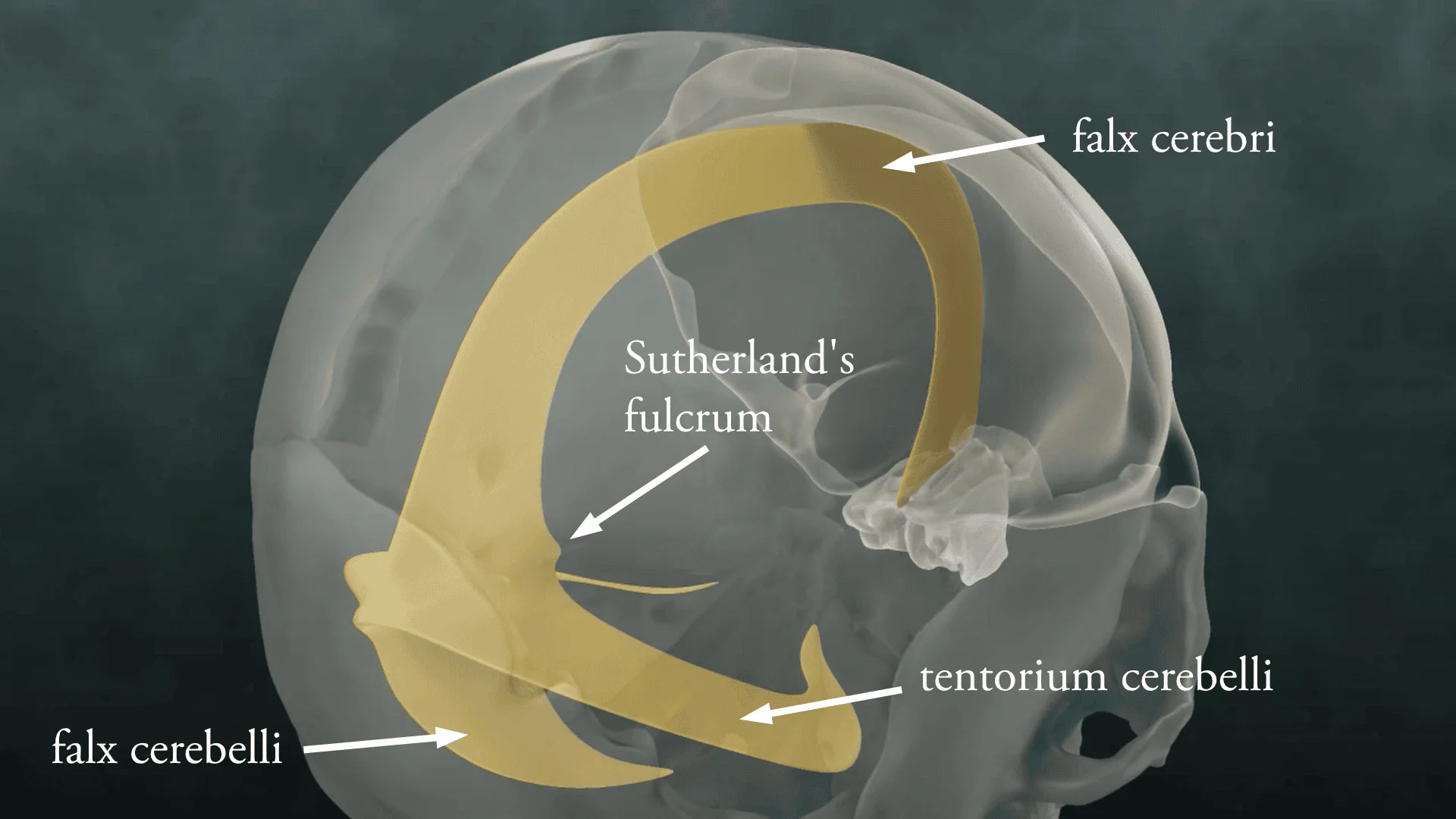
The sickle shape is functional, not incidental. Sutherland compared it to a scythe: you do not chop with one, you swing it in a long arc close to the ground, and as the blade travels forward the tips travel backward. The same opposing motion happens intracranially. As the membrane moves anteriorly during inhalation, the anterior tips of the falx and tentorium move posteriorly. The ethmoid and occiput rotate in one direction while the sphenoid rotates in the other, like three intermeshed cog wheels.
Why “Reciprocal Tension”
The membrane is always under tension. Not intermittently, and not only during treatment.
Sutherland emphasized this because a reciprocal mechanism cannot function without continual tension. It holds in neutral positions and in strain patterns alike.
His model was deliberately simple. Set up two poles and connect them at the top with a taut wire. Pull one pole and the other follows. Reverse the pull and both return. That is reciprocal action, and the tension in the wire is what transmits it. A slack wire transmits nothing.
He extended the two-pole image to explain lesion patterns. In a sleet storm, wires load with ice and pull the poles out of position. The same occurs when traumatic force, whether during birth or from a later fall, pulls on the dura and draws bones out of position. The membranes are therefore also the route back: they are used to reduce those lesions and restore relationship.
Sutherland’s Fulcrum
For a membrane system to move bone, it needs a fulcrum. A fulcrum is a still point that provides mechanical advantage, the way a crowbar needs a pivot to lift anything.
In the cranium, that point sits where the falx adjoins the tentorium, in the region of the straight sinus. Sutherland was precise in his language here: the falx does not join the tentorium. The fulcrum lies in between.
We call this point Sutherland’s Fulcrum. In the biodynamic literature it is understood as an organizing fulcrum laid down during early embryological development, ideally located in the anterior aspect of the straight sinus where it meets the great cerebral vein of Galen. As it shifts, membranes and bones move around it with coherence.
Beyond the Skull
The RTM does not stop at the foramen magnum. There is a reciprocal tension membrane of the spinal canal, a continuation of the inner layer of cranial dura mater. It attaches firmly to the rim of the foramen magnum and runs to the sacrum, linking the two bones through a membrane under tension.
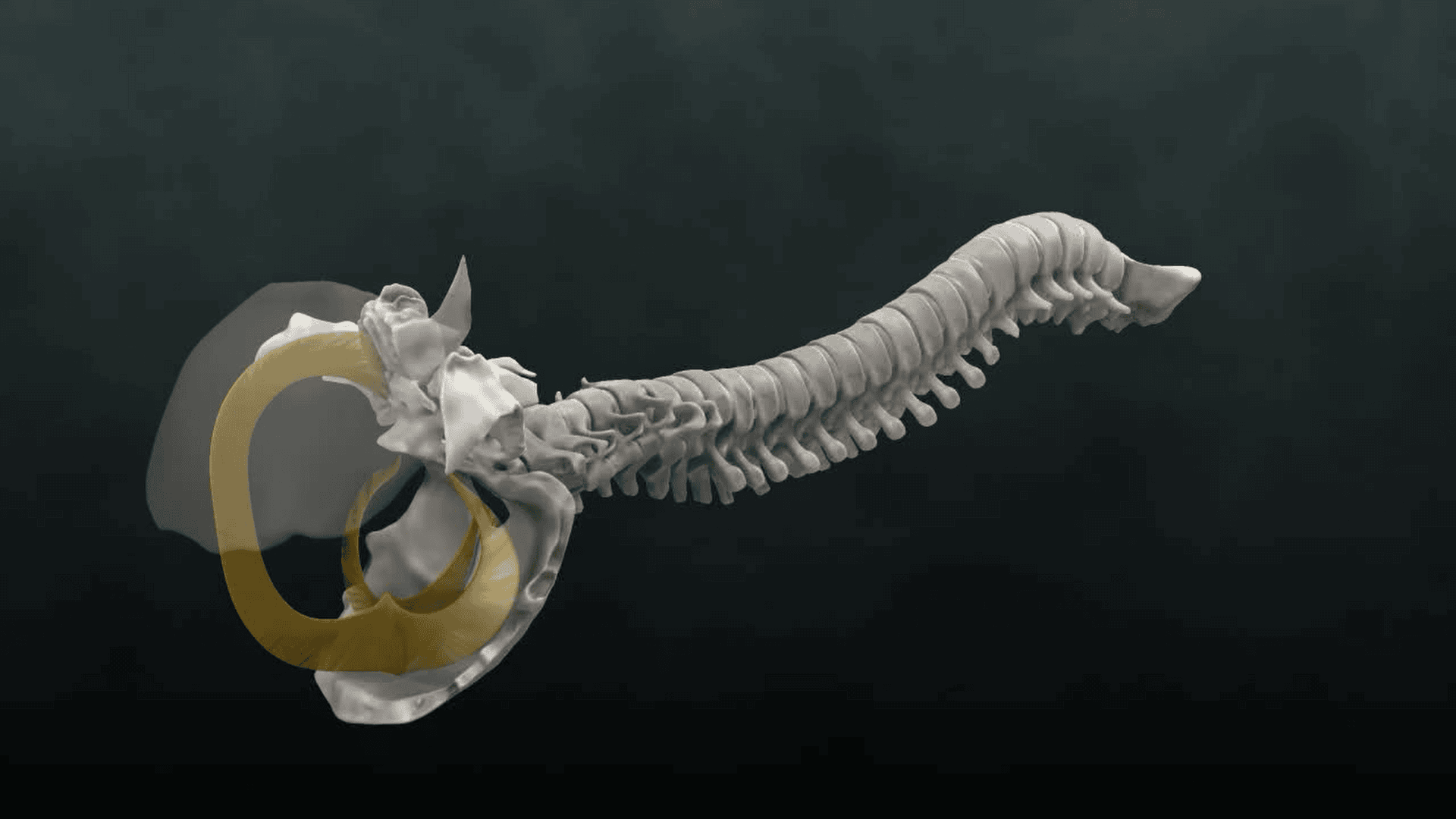
When the occiput rotates into flexion, the foramen magnum is carried higher and that tension lifts the sacrum at the other end. When it rotates into extension, the foramen magnum drops back and the sacrum settles accordingly.
What This Feels Like in Practice
The RTM expresses primary respiratory motion in reciprocal cycles of tensile motion, first in one direction and then the other. During inhalation it moves anteriorly and the cranium shortens front to back, shortens top to bottom, and widens side to side.
What you perceive depends on the level at which you listen.
Through the cranial rhythmic impulse (roughly 8 to 14 cycles per minute), tissue motions tend to be perceived as separate relationships.
Through the mid-tide (around 2.5 cycles per minute), the picture widens. Reciprocal tension motion may be perceived throughout the body as one thing. The RTM is sensed as a unified structure expressing unified tensile motion, and bone, membrane, fluid, and potency stop registering as separate parts. In the biodynamic model we think of the membranes rising in inhalation and settling in exhalation, like kelp moved by tidal forces in the depths of the ocean.
Ideally, reciprocal tension motion is perceived as a shift in tensile dynamics around Sutherland’s fulcrum, balanced and easy in both directions. Where it is not balanced, you have information. The inertial fulcrums a system has organized itself around represent that person’s history.
A Note on Approach
There is a difference between perceiving the fulcrum and going looking for it.
Intention applied forcefully generates motion, and that motion is yours, not the system’s. It is entirely possible to follow a pattern of your own making and mistake it for a finding.
The membrane does not require you to move it. It requires a field held steadily enough that the system is willing to reveal where it already is. For more on how that capacity is built through the practitioner fulcrum and the practices that anchor it, read Tools of the Trade: Calming and Focusing the Mind and Tools of the Trade: Integration of Tension Technique.
It also takes time. Sutherland practiced for over fifty-four years. Rollin Becker completed an estimated sixty-five thousand sessions across fifty-five years. This work is a lifetime journey.
For a systematic treatment of membrane dynamics alongside the perceptual practices that make them accessible, see our Biodynamic Craniosacral course, or browse all available courses
Leave a Reply